
How Does TMS Help Treatment-Resistant Depression? A Complete Guide
TMS helps treat treatment-resistant depression by using magnetic pulses to stimulate mood-regulating areas of the brain that are less active in depression. It offers a drug-free option for adults whose depressive symptoms haven't improved enough after trying antidepressants. In studies, many patients improve, and some reach remission, though results vary from person to person.
If you've been through medication after medication and still feel stuck, you're not failing treatment. Treatment may simply not be a good match for you yet. This guide explains what treatment-resistant depression really means, how TMS for treatment resistant depression works, and what to ask before you decide. At California TMS Clinics in Santa Monica, our team talks with people in this exact position every week.
Key Takeaways
- TRD is common enough to have a name. It usually means major depression that hasn't responded to at least two adequate antidepressant trials.
- TMS is non-invasive and drug-free. You stay awake, and there's no anesthesia or sedation.
- NeuroStar is FDA-cleared for adults with major depressive disorder who haven't improved enough on antidepressants in their current episode.
- Results vary. In one real-world study of 615 patients, 83% reported meaningful improvement, and 62% reached remission after a full course.
- A typical course is 36 sessions, about 20 minutes each, at least five days a week.
- TMS isn't a cure. Symptoms can return, so follow-up planning matters.
What Is Treatment-Resistant Depression?
Treatment-resistant depression (TRD) is a major depression that hasn't improved after adequate trials of treatment. Experts don't have a single agreed-upon definition, but the most common one is failure to respond to at least two antidepressants given at the right dose for the right length of time.
The STAR*D study examined successive treatment steps for adults with major depressive disorder. Using the study's self-reported symptom measure, remission rates were approximately 37% at the first step, 31% at the second, 14% at the third, and 13% at the fourth. These figures describe outcomes across study treatment steps; they do not mean that each individual becomes less likely to benefit from every subsequent treatment. If depression persists, a clinician can review the diagnosis, previous treatment trials, and other evidence-based options.
How Does TMS Work for Treatment-Resistant Depression?
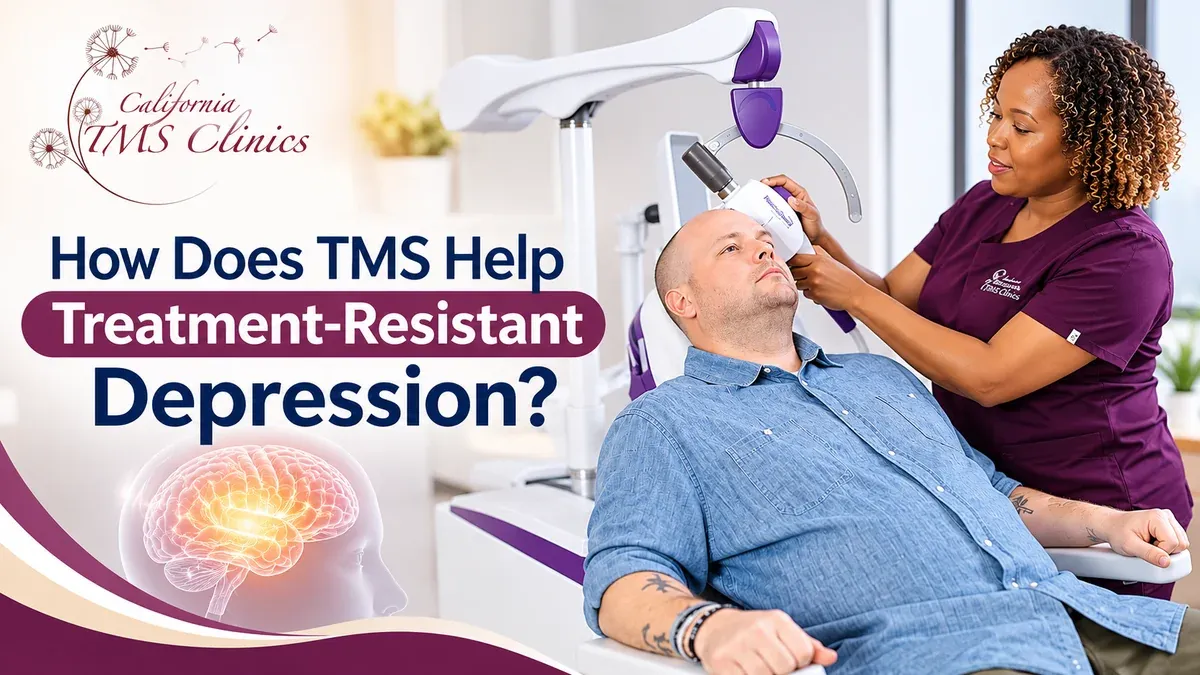
TMS delivers brief magnetic pulses to targeted brain regions involved in mood regulation, commonly the prefrontal cortex. Repeated stimulation is thought to influence neural activity in circuits associated with depression. The exact mechanisms through which TMS improves symptoms are still being studied, and depression does not have one single cause.
Here is what happens in plain terms:
- A coil rests on your head. It sits lightly over the treatment area, usually the left prefrontal cortex.
- Pulses create tiny electrical currents. These stimulate nerve cells in that area.
- Sessions repeat over weeks. Regular stimulation builds on itself.
- No medication enters your bloodstream. That's why TMS avoids many body-wide medication side effects.
TMS is delivered while you are awake, without general anesthesia. Your team will explain what you may feel and any precautions that apply to you.
Is TMS FDA-Cleared for Treatment-Resistant Depression?
Yes, for adults with major depressive disorder who haven't achieved satisfactory improvement from antidepressant medication in their current episode. That's the indication for NeuroStar, the system we use at our clinic.
You can learn more about NeuroStar TMS and how its precision technology works. Note that clearance depends on the diagnosis and treatment history, not on a single definition of TRD, which is one reason a physician evaluation comes first.
How Well Does TMS Work for Treatment-Resistant Depression?
For many people, TMS meaningfully reduces depressive symptoms, but it doesn't work for everyone. In a real-world study of 615 patients, 83% reported meaningful improvement, and 62% reached remission after a full course (Sackeim et al., 2020).
Here is the bigger picture:
- Study results vary because of who was included, how treatment was given, and how improvement was measured. In the NeuroStar registry, response and remission rates changed with the measurement method and the group counted.
- Your treatment history helps your clinician plan your next step. It isn’t just how many medications you’ve tried. It also matters how well each one was tested, how severe your symptoms are, and your overall health.
- TMS isn't permanent. Symptoms can return, and some people choose follow-up or repeat treatment with their physician.
No clinic can promise a result, and you should be wary of any that does.
What Other Depression Treatment Options Exist for TRD?
TMS is one option among several, and the right choice depends on your history. A psychiatrist can walk you through the full list, which often includes:
- Adjusting medication. Changing the dose, switching, or adding a second medication.
- Psychotherapy. Cognitive behavioral therapy and other talk therapies, alone or alongside medication.
- TMS. A non-invasive, in-office option with no anesthesia.
- Esketamine nasal spray. An FDA-approved option given in a certified setting.
- ECT. Electroconvulsive therapy, given under anesthesia, often for severe or urgent cases.
Many people combine approaches, so you don't have to choose just one.
What Does TMS Treatment Involve?
TMS is usually delivered during repeated outpatient appointments over several weeks. California TMS Clinics describes a typical NeuroStar course as 36 sessions, with appointments generally scheduled five days per week. The exact number, frequency, and duration of sessions depend on the prescribed protocol and your clinician's recommendations.
A visit usually looks like this:
- Settle in. You recline in a comfortable chair.
- Coil placement. Your technician positions the coil using measurements from your first visit.
- Treatment. You hear clicking and feel light tapping on your scalp for about 20 minutes.
- Back to your day. Most people drive themselves home and return to normal activities.
Who Is a Good Candidate for TMS?
You may be eligible for a TMS assessment if you have major depressive disorder and have not achieved satisfactory improvement with antidepressant medication. Your clinician will review your treatment history, medical history, safety considerations, and treatment goals before determining whether TMS is appropriate.
We review these carefully before starting:
- Metal implants or devices near the head.
- A history of seizures or epilepsy.
- Bipolar disorder, because of a rare risk of mania.
- Other health conditions your physician wants to consider.
NeuroStar has a separate indication as an adjunct treatment for major depressive disorder in adolescent patients ages 15–21. Eligibility and the treatment plan require a clinician's assessment.
What Are the Side Effects?
The most common side effect associated with NeuroStar TMS is pain or discomfort at or near the treatment site. These effects are usually temporary and, for most patients, do not continue beyond the first week of treatment. TMS also carries a rare risk of seizure, reported by NeuroStar as fewer than 0.1% per patient.
Where Can I Find TMS for Depression in Los Angeles?
California TMS Clinics serves patients from across Los Angeles County and Beverly Hills. If you're exploring TMS depression treatment in Los Angeles, a board-certified psychiatrist oversees your care from your first consultation to your final session.
We also help you check your insurance before you start, since many plans cover TMS for major depression when their criteria are met. Coverage varies, so we verify your benefits first.
Depression often comes with worry, tension, and racing thoughts. If that sounds familiar, you can read how TMS Therapy for Anxiety is used when anxiety symptoms occur alongside depression.
Frequently Asked Questions
Q1.What is TMS for treatment-resistant depression?
It's a non-invasive treatment that uses magnetic pulses to stimulate a mood-related brain area. It's used when depression hasn't improved enough with antidepressants.
Q2.How many antidepressants do I need to try before TMS?
It depends on your plan and your clinician. NeuroStar's clearance refers to inadequate improvement from antidepressants in your current episode, while many insurers require more. We'll check your plan.
Q3.How long does TMS take to work?
Some people notice changes within a few weeks, while others need the full course. Timing varies.
Q4.Does insurance cover TMS for treatment-resistant depression?
Often, when the plan's criteria are met, coverage differs by plan, so we verify your benefits before you start.
Q5.Is TMS better than antidepressants?
They're different tools. TMS may suit people who haven't improved on medication, and it avoids body-wide medication side effects. Many people use both.