

What Is TMS Therapy and How Does It Work? A Complete Guide
TMS therapy uses gentle magnetic pulses to stimulate the part of your brain that helps regulate mood, and it fits into your day more easily than most people think.
If you're thinking about TMS therapy, you probably have practical questions. What happens when you sit in the chair? Does it hurt? How long will it take? At California TMS Clinics in Santa Monica, our psychiatrist-led team hears these questions every week, so we wrote this guide to answer them in plain language. By the end, you'll know what a session is like and how treatment unfolds from the first visit to the last.
Did you know?
According to the National Institute of Mental Health, roughly estimate of 21 million people in the U.S. have had at least one major depressive episode, and many of them try more than one medication before finding relief. If that sounds like your story, you're far from alone, and it's worth knowing every option before you decide what comes next.
So let's start at the beginning, with what TMS actually is and what it does inside the brain.
Key Takeaways
- TMS stimulates a mood-related part of the brain using magnetic pulses, and no surgery is involved.
- You stay awake and can go back to your day right after.
- A typical course is 36 sessions, about 20 minutes each.
- Results build over weeks, not after one visit.
- Side effects are usually mild, and screening comes first.
- Treatment plans are personal, and not everyone responds.
What Is TMS Treatment and What Does It Do?
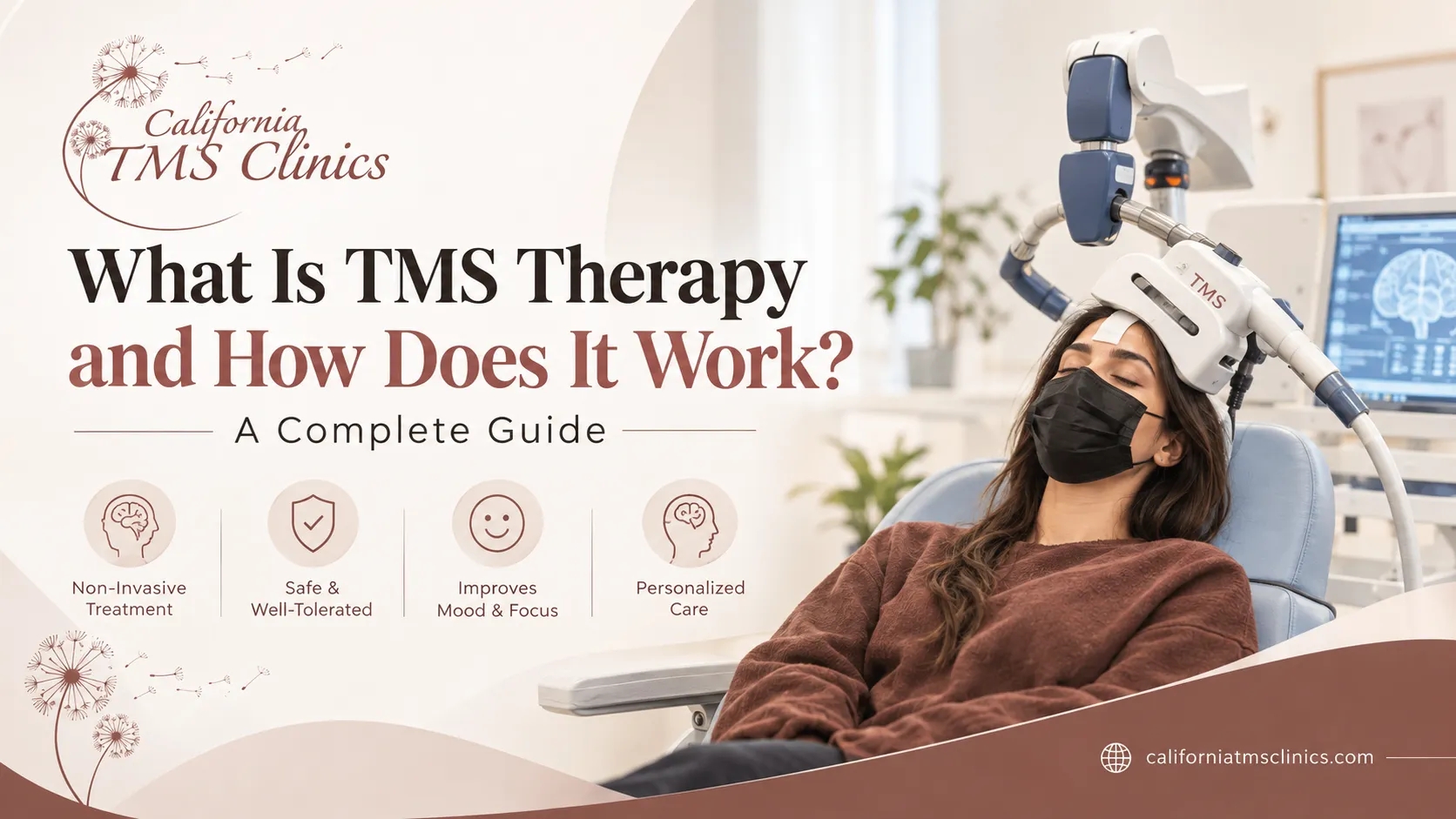
TMS stands for transcranial magnetic stimulation. A small magnetic coil rests against your scalp and sends short pulses to a mood-related area of the brain. You don't need surgery or anesthesia, and you stay awake the whole time.
The FDA first cleared the NeuroStar TMS System in 2008 for treating major depressive disorder in adults who had not received satisfactory improvement from prior antidepressant treatment. NeuroStar's current system also has an FDA-cleared indication for adolescent patients ages 15–21 as an adjunct treatment for MDD.
How Does TMS Work as a Therapy for Depression?
The coil makes a magnetic field, similar in strength to an MRI machine's. That field passes through your skull and nudges nerve cells in a region linked to mood. NeuroStar describes this region as one that may be underactive in people with depression.
Doctors are honest that the full story isn't settled. Mayo Clinic's expert Q&A says it plainly: "It's not clear exactly how transcranial magnetic stimulation eases depression." What we do know is how the treatment is delivered and what to expect from it. That's why your plan is personal: the coil's position and the pulse strength are set for you.
What Happens During TMS Therapy on Your First Visit?
Your first visit is usually longer than subsequent sessions because your provider needs to complete the initial mapping and treatment settings. Here's the usual flow:
- Mapping. Your psychiatrist finds the right spot for the coil.
- Setting your strength. The team finds the pulse level that works for you.
- Settling in. You sit back in a comfy chair and wear earplugs during the session.
- Beginning therapy. You'll hear clicking and feel a little tapping on your scalp.
After that, sessions follow the same simple routine.
Does TMS Therapy Hurt?
Most people feel tapping or mild scalp discomfort. It’s usually strongest in the first week and then dies down. Tell your medical physician if the stimulation seems uncomfortable. Your doctor can alter the therapy settings to make you feel more comfortable.
How Long Does TMS Therapy Take?
At California TMS Clinics, a typical NeuroStar session takes about 20 minutes. NeuroStar says sessions can take as little as 19 minutes, depending on the treatment protocol. After treatment, patients can generally resume normal activities without sedation or a recovery period.
How Many TMS Sessions Will I Need?
A typical full course is 36 sessions, usually at least five per week. In the standard NeuroStar schedule, that's 30 daily sessions over about six weeks, followed by six tapering sessions over about three more. Your psychiatrist sets the final plan based on how you respond.
Don't expect a big change after one visit. NeuroStar reports that most patients who benefit begin experiencing results by the fourth week, although some people notice changes sooner or later.
| Stage | What happens | Typical length |
| First visit | Mapping and strength setting | Up to about 90 minutes |
| Main treatment | Weekday sessions | 30 sessions over about 6 weeks |
| Taper | Fewer sessions | 6 sessions over about 3 weeks |
| Each session | You rest while the coil works | About 20 minutes |
Who May Be a Good Fit for TMS?
TMS is generally considered for people with major depressive disorder who have not received enough improvement from prior antidepressant treatment or who have not tolerated medication adequately. NeuroStar also has an FDA-cleared indication for adolescent patients ages 15–21 as an adjunct treatment for MDD. Whether TMS is appropriate depends on an individual clinical evaluation.
Benefits and Side Effects of TMS
There are no pills to swallow and no recovery time. And because TMS doesn't travel through your bloodstream, it doesn't cause the body-wide side effects some medications do. To learn more about the benefits of TMS therapy, get in touch with a professional and talk it through in person.
Side effects are usually mild. The most common side effects are scalp discomfort and headaches, and these usually ease up within the first week. Seizures are rare, at about 0.1% per patient or less. Tell your doctor about any metal in or near your head, since non-removable metal rules TMS out.
Is TMS Treatment Right for You?
Deciding whether TMS is appropriate starts with a proper clinical evaluation.
If depression symptoms have continued despite previous treatment, asking a qualified provider about TMS may be a reasonable next step. The conversation can help you understand whether your history, symptoms, and treatment goals make you a potential candidate.
People doing research on TMS therapy in California have the same problem – the treatment should be based on an individualized clinical assessment, not a generic checklist.
Before beginning, consider asking:
- What type of TMS protocol do you recommend?
- How often will I need to attend?
- How long will each appointment take?
- What side effects should I watch for?
- How will you measure whether treatment is helping?
- What happens if I do not respond as expected?
- What will my ongoing treatment plan look like afterward?
Clear solutions can make the decision seem a lot less daunting.
Take the Next Step Toward Understanding Your Options
If depression continues to affect your mood, energy, relationships, or everyday life despite previous treatment, it may be worth learning about other options.
TMS therapy is a noninvasive form of brain stimulation that may be effective for some people with depression, but the exact treatment plan relies on your symptoms, medical history, and past treatment experience. You don’t have to figure that out by yourself. By talking with a trained TMS provider, you may learn how treatment works, what a typical course looks like, and whether you might be a candidate.
Reach out to California TMS Clinics to discuss your treatment options with our Santa Monica team. We can answer your questions, explain what to expect from TMS, and help you understand whether a consultation may be the right next step.
Frequently Asked Questions
Q1.What does TMS therapy feel like?
Most people feel tapping and mild scalp discomfort, plus clicking sounds. You stay awake and seated.
Q2.How long does a TMS session take?
About 20 minutes at our clinic. Your first visit takes longer because of mapping.
Q3.How many TMS sessions will I need?
A typical course is 36 sessions. Your psychiatrist builds the exact plan.
Q4.When does TMS start working?
Some patients who benefit begin noticing improvement within the first few weeks. NeuroStar reports that most patients who benefit begin experiencing results by the fourth week, although individual responses vary.
Q5.Is TMS the same as ECT?
No. TMS keeps you awake, uses magnetic pulses, and doesn't cause a seizure.
Q6.Is TMS therapy safe?
TMS is generally well tolerated; however, there are possible hazards and adverse effects. Before treatment, your provider will screen for relevant medical problems, implanted devices, metal around the head, and other safety considerations.